The Twelve Animals of the Chinese Zodiac and Their Elements
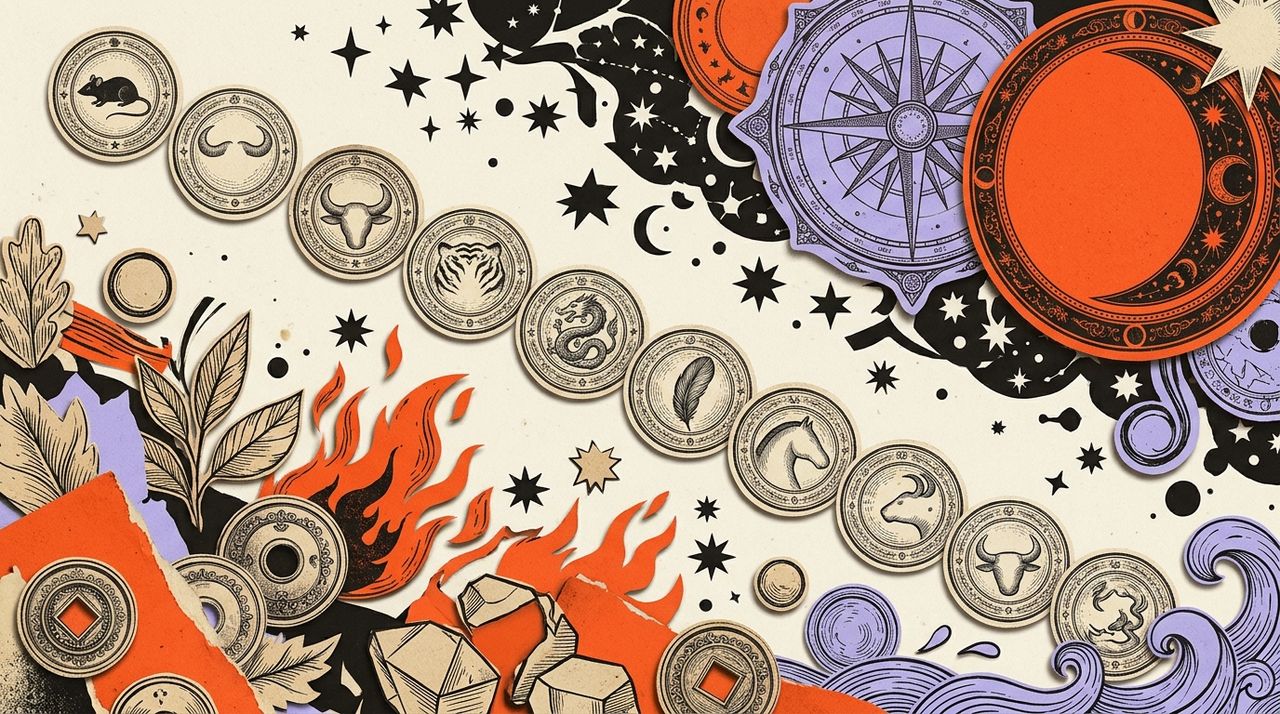
The Chinese zodiac is based on a cycle of twelve years, each associated with an animal. Unlike the Western zodiac, which divides the sky into twelve sectors, it assigns one sign to an entire birth year. To this animal are added an element and a polarity (yin or yang), which gives a combination repeating every sixty years.
Origin and principle
The Chinese calendar is lunisolar: it combines the phases of the Moon and the course of the Sun. The twelve "earthly branches" that designate the years have been used in China to count time for a very long while, and the animals were linked to these branches over the centuries. Several popular tales explain the order of the animals, notably that of a race organised by a mythical emperor. These are legends, not established historical facts.
Chinese New Year falls between late January and mid-February. A person born in January or early February may therefore belong to the animal of the previous year: you need to check the exact date of Chinese New Year in your birth year.
The twelve animals and their recent years
| Animal | Recent years |
|---|---|
| Rat | 1996, 2008, 2020 |
| Ox | 1997, 2009, 2021 |
| Tiger | 1998, 2010, 2022 |
| Rabbit (or Cat) | 1999, 2011, 2023 |
| Dragon | 2000, 2012, 2024 |
| Snake | 2001, 2013, 2025 |
| Horse | 2002, 2014, 2026 |
| Goat | 2003, 2015, 2027 |
| Monkey | 2004, 2016, 2028 |
| Rooster | 2005, 2017, 2029 |
| Dog | 2006, 2018, 2030 |
| Pig | 2007, 2019, 2031 |
To find your animal, you add or subtract twelve, as many times as needed, until you land on a year in the table.
The five elements
Each year is also linked to one of the five elements of Chinese thought: wood, fire, earth, metal and water. One element governs two consecutive years, one yang, the other yin. The last digit of the year gives a simple rule:
- 0 and 1: metal;
- 2 and 3: water;
- 4 and 5: wood;
- 6 and 7: fire;
- 8 and 9: earth.
The year 2026 is thus a year of the Fire Horse. The same animal returns with another element every twelve years, and recovers the same animal and element pair every sixty years. The elements follow two cycles described by the tradition: a generating cycle (wood feeds fire, which creates earth, which holds metal, which produces water, which makes wood grow) and a controlling cycle.
How it is used today
In East Asian countries, the animal of the year is everywhere during New Year celebrations, and it serves as a cultural reference point: people readily ask "what animal are you?". In the West, the practice is mainly of interest for two uses. The first is the description of character traits associated with each animal: the Tiger is said to be bold, the Ox patient, the Monkey ingenious. These portraits are archetypes, not diagnoses.
The second use is compatibility. According to this tradition, some animals get on naturally (for example Rat, Dragon and Monkey form a "triangle" of affinities) while others are said to be opposed. Several people use it for the pleasure of comparing two signs, without making it a rule for living. You can try our compatibility tool to explore this idea.
Beyond the year, the full tradition also speaks of the animal of the month, day and hour of birth, which form the "four pillars" of Ba Zi, a more advanced method.
For an overview, head to the Chinese astrology page.
This practice is a matter of belief and entertainment: it does not replace medical, legal or financial advice.