Astrology
Western astrology
Reading a personality and a period of life from the position of the planets at birth.
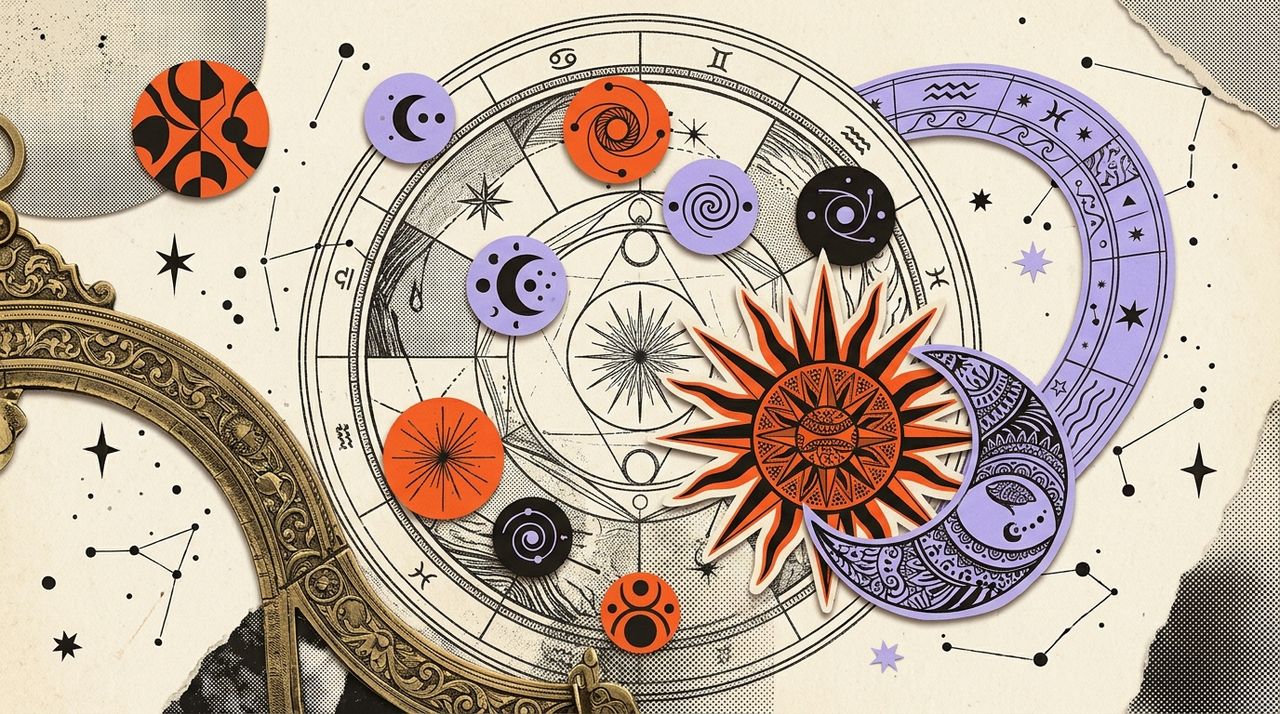
Western astrology, known as tropical astrology, is based on the birth chart: the position of the Sun, the Moon and the planets in the twelve signs and twelve houses at the moment of birth.
It mainly serves as an interpretive framework: a language for talking about yourself, your relationships and the periods you go through. The daily horoscope is its shortest form.
Where it comes from
The roots of Western astrology lie in Mesopotamia, where Babylonian scribes recorded celestial phenomena as omens concerning the king and the kingdom. It was in this world that the zodiac of twelve equal signs was established, during the first millennium BC. The sky there still speaks of the community, not of the individual.
Horoscopic astrology, which reads the sky of a particular birth, took shape in the Hellenistic world, notably in Egypt around Alexandria. In the 2nd century, Ptolemy offered a synthesis of it, the Tetrabiblos, which remained a reference for centuries. Passed on and enriched by scholars of the Arab world, it returned to Europe in the Middle Ages, where it was taught alongside medicine and astronomy.
From the 17th century onwards, astronomy and astrology parted ways: the former became a science, the latter lost its scholarly status. It enjoyed a revival in the 20th century, in two very different forms: the newspaper horoscope, short and aimed at a wide audience, and so-called psychological astrology, which borrows part of its vocabulary from depth psychology and presents itself as a tool for self-knowledge.
What it is based on
A reading combines four families of elements. The planets, to which astrology adds the Sun and the Moon, represent functions: self-assertion, sensitivity, thought, desire, action. The signs indicate the way these functions are expressed. The houses locate the area of life concerned: home, work, relationships. Finally, aspects are the angles formed between planets, harmonious or tense according to tradition.
Each sign is linked to an element (fire, earth, air, water) and a mode (cardinal, fixed, mutable). The ascendant, the sign that was rising on the horizon at the moment of birth, opens the first house and plays an important role in interpretation. An astrologer does not read an isolated element: they look for dominant features and tensions, then put them together into a nuanced portrait, without a single verdict.
Try it
How it is practised
The chart is calculated from the date, time and place of birth; transits are then observed, that is, the current sky compared with the sky at birth.
Before a consultation, the astrologer asks for the date, exact time and place of birth, since the ascendant and the houses change within a few minutes. An unknown time limits the reading to the planets and signs. Many people come with a question about a period of their life: a career change, a relationship, a stage of life. A session often lasts between half an hour and an hour and a half.
The consultation can take place in an office, by telephone or by video call, since the basis is a calculation and not an object that is handled. Some astrologers provide a written summary or an annotated chart. Other formats exist: synastry compares two charts, the solar return looks at the coming year. Many people also learn to read their own chart on their own.
What to expect
Astrology offers a symbolic vocabulary for putting words to a temperament, a hesitation or a period of transition. Done well, a consultation helps you to step back and formulate your own questions. Its predictive effects have not been demonstrated by scientific studies, and it is more accurate to regard it as a support for reflection than as a forecast. It does not replace medical, legal or financial advice, or psychological support. It is offered for entertainment purposes.
Be wary of a reading that announces certain misfortune, fixes a date for a meeting or a death, or urges you to book more and more paid consultations to "monitor" a transit. A reputable astrologer presents trends, not certainties, and leaves you free to make your own choices. A price stated in advance and a session that does not try to worry you are good signs.
Glossary
- Ascendant
- The zodiac sign that was rising on the horizon at the time and place of birth. It depends heavily on the time.
- House
- One of the twelve sectors of the chart, each associated with an area of life such as family, money or relationships.
- Aspect
- An angle formed between two planets, for example the conjunction, the square or the trine. Tradition describes them as flowing or tense.
- Retrograde motion
- The apparent movement of a planet that seems to move backwards in the sky as seen from Earth. Astrology gives it a meaning of return or revision.
- Synastry
- A comparison of two birth charts to describe the affinities and frictions in a relationship.
- Tropical zodiac
- A division of the signs starting from the spring equinox, used in the West. It no longer coincides with the constellations of the same name.
Frequently asked questions
How do I find out my ascendant?
You need your date, time and place of birth. The time is often shown on the full birth certificate. Chart-calculation software or a website then gives you the ascendant in a few seconds.
What is the difference between a Sun sign and a birth chart?
The Sun sign only indicates where the Sun was at your birth. The birth chart brings together all the planets, the houses, the ascendant and the aspects. Newspaper horoscopes rely only on the former.
Is astrology a science?
No. It was long taught alongside astronomy, but it is no longer recognised as a science, and tests of its predictions have not produced convincing results. Its practitioners now present it mainly as a symbolic language.
What does Mercury retrograde mean?
It is a period, several times a year, when Mercury appears to move backwards in the sky. According to astrological tradition, it is a time to reread, check and revisit your plans rather than start new ones.
Articles on Western astrology
These practices are a matter of belief and entertainment: they are no substitute for medical, legal or financial advice, nor for professional support.
Other practices
Chinese astrology
Twelve animals, five elements and yin and yang, based on the year of birth.Vedic astrology
Indian Jyotish, based on the sidereal zodiac and the lunar mansions.Mayan astrology
The 260-day sacred calendar and its twenty glyphs.Human Design
A recent system combining astrology, the I Ching and the chakras.Numerology
The life path and the numbers drawn from your date of birth and name.Angel numbers
The meaning given to repeated number sequences: 111, 222, 333…
Get your horoscope every morning
Free, by email, with the occasional offer from a partner psychic platform. Unsubscribe in one click.