Astrology
Chinese astrology
Twelve animals, five elements and yin and yang, based on the year of birth.
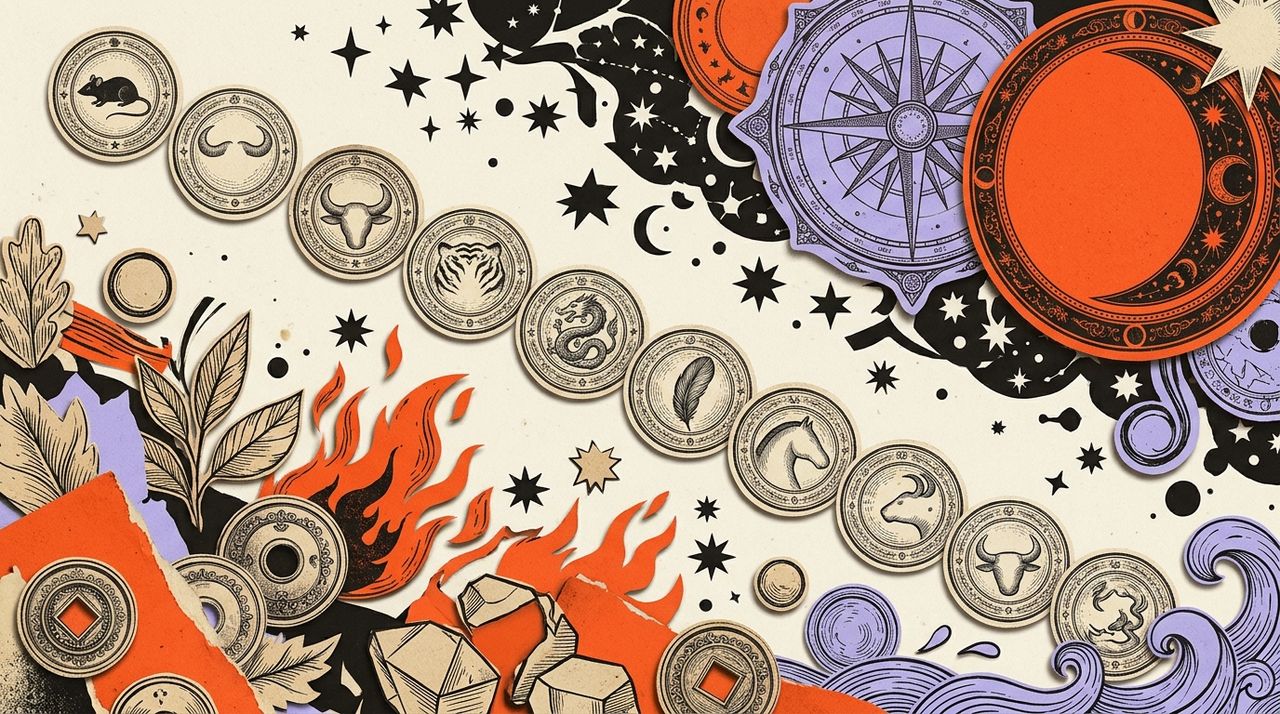
Chinese astrology links each year to one of twelve animals (Rat, Ox, Tiger, Rabbit, Dragon, Snake, Horse, Goat, Monkey, Rooster, Dog, Pig) and to one of five elements: wood, fire, earth, metal, water.
It follows the lunar calendar: the year changes at Chinese New Year, between late January and mid-February, which matters for people born early in the year.
Where it comes from
Chinese astrology rests on very ancient frameworks of Chinese thought: the pairing of yin and yang, the five phases and the sexagenary cycle, which combines ten "heavenly stems" and twelve "earthly branches" to form a cycle of sixty units. This cycle was first used to count days, then years, long before it was associated with personal divination.
The twelve animals became attached to the earthly branches over the centuries. A popular legend tells of a race organised by the Jade Emperor to settle their order, but this is a tale and not a historical origin. The four pillars method, which is more scholarly, developed gradually, and tradition associates its classical form with the Song era.
The system spread throughout East Asia, with local variations: in Vietnam, for example, the Cat replaces the Rabbit. In the West, it is mainly known through the animal of the year, popularised in the 20th century by New Year celebrations and annual horoscopes, a greatly simplified version of an art that remains alive in its countries of origin.
What it is based on
The five phases, often translated as "elements", are not substances but states in motion. They follow one another in a generating cycle, in which wood feeds fire and fire produces earth, and in a controlling cycle, in which water extinguishes fire and metal cuts wood. The reading looks for balance between these phases in a date of birth, and notes those that are missing or dominant.
In the four pillars, each pillar combines a heavenly stem and an earthly branch, making eight characters in total. The day stem represents the person themselves, and the other characters are read in relation to it. People also speak of compatibilities and oppositions between animals, for example between animals six places apart.
Try it
How it is practised
A simple reading starts from the animal of the year; a full reading, the "four pillars", combines the year, month, day and hour of birth.
For a full study, the practitioner asks for the date and time of birth, which they convert into the traditional Chinese calendar. The hour is divided into twelve two-hour periods, each linked to an animal. Questions often concern character, the choice of a career path, a coming year, a partnership or a marriage. A consultation generally lasts between thirty minutes and an hour.
The reading can take place in person, by telephone or by video call. In Chinese communities, people sometimes consult to choose an auspicious date (opening a business, moving house), which brings the practice closer to the almanac. In personal practice, many simply look up their animal and element, then read the general forecasts published for the year.
What to expect
This form of astrology offers a framework of balance, useful for reflecting on one's tendencies and rhythms, and a shared language that forms part of the culture of many Asian countries. It cannot predict events with certainty, and compatibility between animals should never be the sole basis for deciding on a relationship or a hire. It is no substitute for medical, legal or financial advice, nor for psychological support.
Be wary of offers that link a "dangerous" year to the compulsory purchase of amulets, bracelets or costly rituals to protect yourself. Tradition speaks of more delicate years, but an honest practitioner does not sell fear. A clear price and advice that leaves the decision in your hands are good signs.
Glossary
- Bazi
- The Chinese name for the Four Pillars method, literally "eight characters". It refers to the two characters for the year, month, day and hour.
- Heavenly Stem
- One of the ten signs associated with the five phases, each in a yin and a yang version. It forms the upper half of each pillar.
- Earthly Branch
- One of the twelve signs corresponding to the animals of the zodiac. It forms the lower half of each pillar.
- Wu xing
- The five phases: wood, fire, earth, metal and water. They describe transformations rather than substances.
- Birth year (ben ming nian)
- A year that comes round every twelve years with the same animal as the one of your birth. Tradition regards it as a year to approach with caution.
- Day Master
- The Heavenly Stem of the day pillar, which represents the person in a Four Pillars reading.
Frequently asked questions
What is my Chinese sign if I was born in January?
It depends on the date of Chinese New Year in your birth year. If you were born before it, your animal is that of the previous year. Some practitioners instead use the start of the solar spring, around 4 February.
How do I find my Chinese element?
The element of the year is worked out from the last digit of the birth year: 0 and 1 for metal, 2 and 3 for water, 4 and 5 for wood, 6 and 7 for fire, 8 and 9 for earth. The birth year must first be adjusted according to Chinese New Year.
Which Chinese signs are compatible?
Tradition groups the animals into four triangles of affinity, for example Rat, Dragon and Monkey. It also points to oppositions between animals six places apart. These are symbolic pointers, not rules.
Why is it said that the year of your own sign brings bad luck?
According to tradition, the year that returns with your own animal clashes with your birth year. Many people then wear red, as is customary. This is a cultural belief with no established predictive value.
Articles on Chinese astrology
These practices are a matter of belief and entertainment: they are no substitute for medical, legal or financial advice, nor for professional support.
Other practices
Western astrology
Reading a personality and a period of life from the position of the planets at birth.Vedic astrology
Indian Jyotish, based on the sidereal zodiac and the lunar mansions.Mayan astrology
The 260-day sacred calendar and its twenty glyphs.Human Design
A recent system combining astrology, the I Ching and the chakras.Numerology
The life path and the numbers drawn from your date of birth and name.Angel numbers
The meaning given to repeated number sequences: 111, 222, 333…
Get your horoscope every morning
Free, by email, with the occasional offer from a partner psychic platform. Unsubscribe in one click.