The Tzolk'in, the 260-Day Sacred Maya Calendar
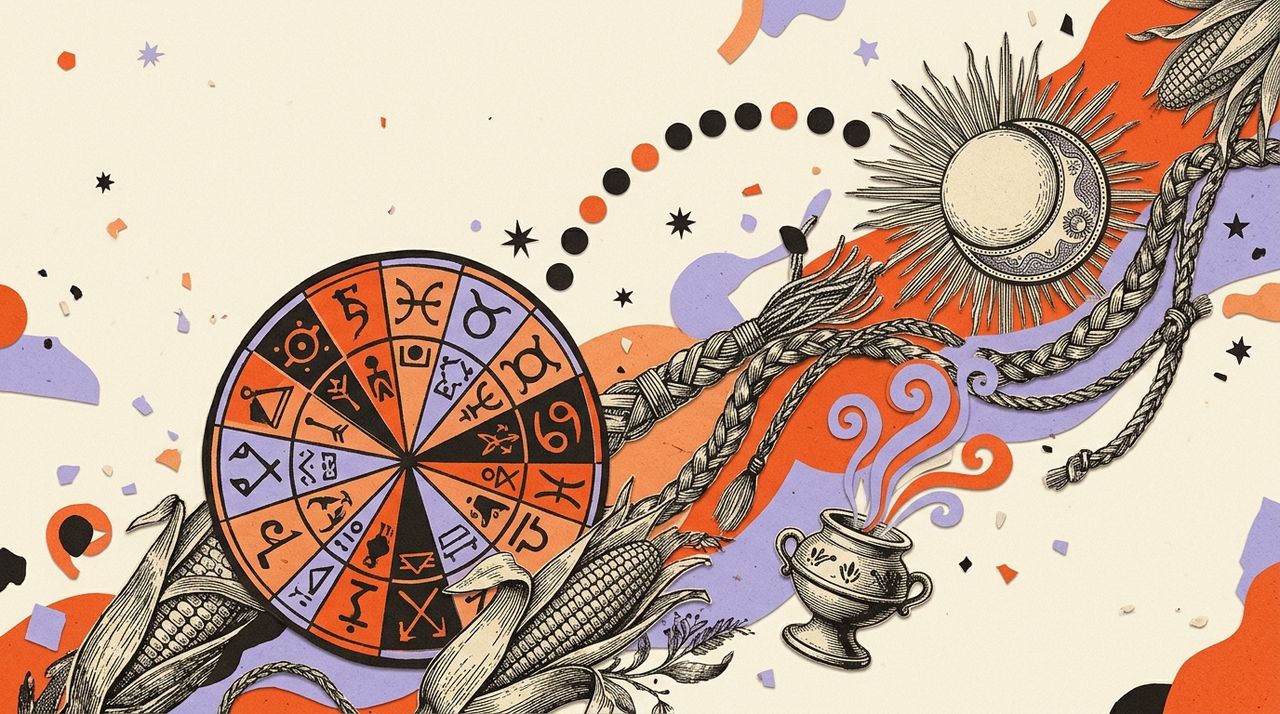
The Tzolk'in is the ritual calendar of the Maya peoples. It has 260 days and differs from our 365-day solar year. Documented by inscriptions, codices and colonial accounts, it is still practised today in some communities of Central America. It is also the basis of what is called, in esoteric circles, Maya astrology.
How the cycle works
The Tzolk'in combines two series that turn in parallel:
- a series of thirteen numbers, from 1 to 13;
- a series of twenty day names, which recur in a fixed order.
Each day bears a number and a name, for example "4 Ajaw". The two series advance together by one step each day. It takes 260 days (13 multiplied by 20) before the same combination returns. Among the day names, often quoted in their Yucatec form, are Imix, Ik', Ak'b'al, K'an, Chikchan, Kimi, Manik', Lamat, Muluk, Ok, Chuwen, Eb', Ben, Ix, Men, Kib', Kab'an, Etz'nab', Kawak and Ajaw. Spellings vary with the language and the period.
The exact origin of the 260-day length is unknown. Several hypotheses are put forward: a link with human gestation, with agricultural cycles or with astronomical observations. None has won consensus among specialists.
The Tzolk'in and the Haab'
The Maya also used the Haab', a 365-day solar calendar: eighteen months of twenty days, followed by five additional days considered precarious, the Wayeb'. Combining the Tzolk'in and the Haab' gives a composite date, for example "4 Ajaw 8 Kumk'u". The same combination returns only after 18,980 days, or 52 Haab' years. This period is called the Calendar Round. To date events over longer spans, the Maya also used the Long Count.
A ritual and divinatory use
In the Maya tradition, each day of the Tzolk'in has a particular character and energy. In the highlands of Guatemala, calendar specialists (the "day keepers", ajq'ij in the K'iche' language) still consult this cycle to set dates for ceremonies, sowing or family events. A person's birth day is also read in it, thought to influence their temperament and vocation.
It is this last use that inspired contemporary Maya astrology. In its modern version, popularised in the West from the end of the 20th century, a birth "sign" is calculated from the Tzolk'in day, to which some variants add a tone (the number from 1 to 13) and a guide day. These systems are recent adaptations: they borrow Maya vocabulary, but they do not always match traditional practices, and several versions coexist with different calculation methods.
How to approach it today
If the subject interests you, two approaches are possible. The first is cultural: reading works of history and archaeology on the Maya to understand the place of time in their view of the world. The second is personal: calculating your birth sign with an online tool, checking which method it uses, and reading the description as a symbolic portrait to set against your own experience.
It is useful to remember that the calendar is a historical and cultural reality, whereas the personality interpretations drawn from it belong to tradition or modern belief, with no demonstrated scientific validity. For an overview, see the Maya astrology page and, to compare with another system based on birth time, the numerology page.
These practices are a matter of belief and entertainment, and they do not replace medical, legal or financial advice.