Cards and oracles
Yes or no reading
One card, one closed question, one answer to reflect on.
The yes or no reading answers a closed question with a single card, often from the tarot: some cards are read as a yes, others as a no or a 'not yet'.
It is a tool for reflection: it helps you ask yourself what you are hoping to hear, rather than making a decision on anyone's behalf.
Where it comes from
Seeking a binary answer through chance is one of the oldest forms of divination. It is classed under the name cleromancy, divination by casting lots: knucklebones, sticks, pebbles or dice. The Bible mentions the Urim and Thummim, objects entrusted to the high priest which many historians interpret as a means of obtaining a yes or no answer. The French word “sortilège” (spell) in fact comes from the Latin term for someone who draws lots.
The yes or no reading with a tarot card is a recent adaptation. It spread with mass-market cartomancy books, then with online readings, which turned it into a quick and popular format. There is no historical tradition establishing which cards mean yes: each author offers their own grid, often inspired by how bright or dark the card appears.
What it is based on
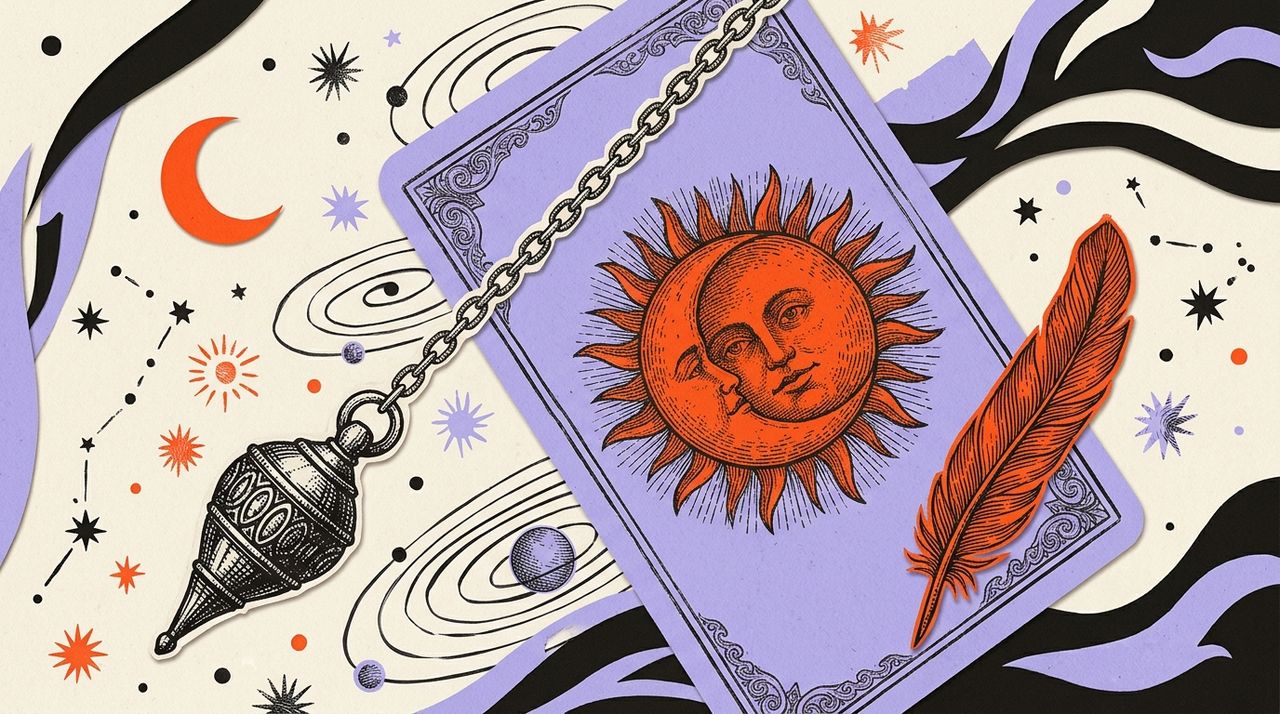
The principle comes down to one rule: a closed question corresponds to one card, classed among the yeses, the noes or the nuanced answers. The Sun, the Star or the World are generally read as a yes; the Tower or the Devil, often as a no; the Hermit or the Moon, as a wait or a situation that is still unclear. The reading is most often done with the major arcana alone, which are easier to interpret.
When the full deck is used, some people associate the suits with tendencies: Cups and Wands rather favourable, Swords more reserved, Pentacles tied to practical matters. A reversed card can turn a yes into a “yes, but” or a “not now”. The same reasoning applies to the pendulum or the tossed coin.
Try it
How it is practised
You phrase a question that can be answered with yes or no, then draw a card.
The yes or no reading is mostly done alone, in a few minutes. You shuffle the cards while concentrating on a precise question, phrased in the present or within a defined timeframe, then draw one. The most useful step comes afterwards: observing your own reaction. Relief or disappointment on seeing the card often says more than the card itself.
In a consultation, the yes or no format sometimes serves as an opening before a more detailed reading, in person, by telephone or in writing. A serious practitioner will readily rephrase a poorly framed question, for example one that contains two questions, or one that depends entirely on another person's will. It is rare for an entire session to be limited to a single answer.
What to expect
You can expect a yes or no reading to prompt a moment of clarity: it forces you to state clearly what you want to know and sometimes reveals the answer you were already hoping for. Its simplicity also makes it an enjoyable exercise. It cannot, however, account for a complex situation, and a single card cannot settle an important decision for you.
This reading is no substitute for medical, legal or financial advice, nor for psychological support: a question about health, legal proceedings or investment deserves a professional. Be wary of a service that offers to repeat paid readings until you get the “right” answer, or that turns a no into a threat to push you into buying more consultation time.
Glossary
- Closed question
- A question that can be answered with yes or no. It is the basic requirement of this reading.
- Cleromancy
- Divination by casting lots, using objects that are thrown or drawn: dice, knucklebones, sticks, cards. The yes or no reading is a modern form of it.
- Major arcana
- The 22 picture cards of the tarot, from the Magician to the World. These are the ones most often used for a yes or no reading.
- Neutral card
- A card read neither as a yes nor as a no, but as a wait, a doubt or a condition. Depending on the grid, the Hermit, the Moon or the Wheel of Fortune are often among them.
- Jiaobei
- A pair of crescent-shaped wooden blocks thrown in Chinese temples to obtain a favourable or unfavourable answer. It is a living example of a binary reading.
- Reversed card
- A card that appears upside down. In a yes or no reading, it often qualifies the answer or indicates a delay.
Frequently asked questions
Is the yes or no reading reliable?
No reading has demonstrated reliability: it is a practice of belief and reflection. The yes or no reading is mainly useful for becoming aware of what you want. It is best regarded as a source of insight rather than a decision. It is offered for entertainment.
Can you repeat a yes or no reading on the same question?
Most practitioners advise against it, at least on the same day. Starting again until you get the answer you want drains the reading of its meaning. If the answer is unwelcome, it is often the question that deserves to be rephrased.
Which tarot cards mean yes?
The grids vary from one author to another, but the Sun, the Star, the World, the Lovers or Strength are frequently read as a yes. There is no official list. It is better to choose one grid and stick to it.
How do you phrase your question well?
A good question is simple, covers a single point and concerns you directly: “is this the right time to put this project forward?” rather than “will he love me and stay?”. Specifying a timeframe helps with interpreting the answer. Avoid questions that depend solely on someone else's choice.
Articles on Yes or no reading
These practices are a matter of belief and entertainment: they are no substitute for medical, legal or financial advice, nor for professional support.
Other practices
Tarot de Marseille
Twenty-two major arcana for reflecting on a question.Belline Oracle
A French 52-card oracle, known for being easy to read.Runes
The 24 signs of the Norse alphabet, drawn like an oracle.Western astrology
Reading a personality and a period of life from the position of the planets at birth.Chinese astrology
Twelve animals, five elements and yin and yang, based on the year of birth.Vedic astrology
Indian Jyotish, based on the sidereal zodiac and the lunar mansions.
Get your horoscope every morning
Free, by email, with the occasional offer from a partner psychic platform. Unsubscribe in one click.