Cards and oracles
Runes
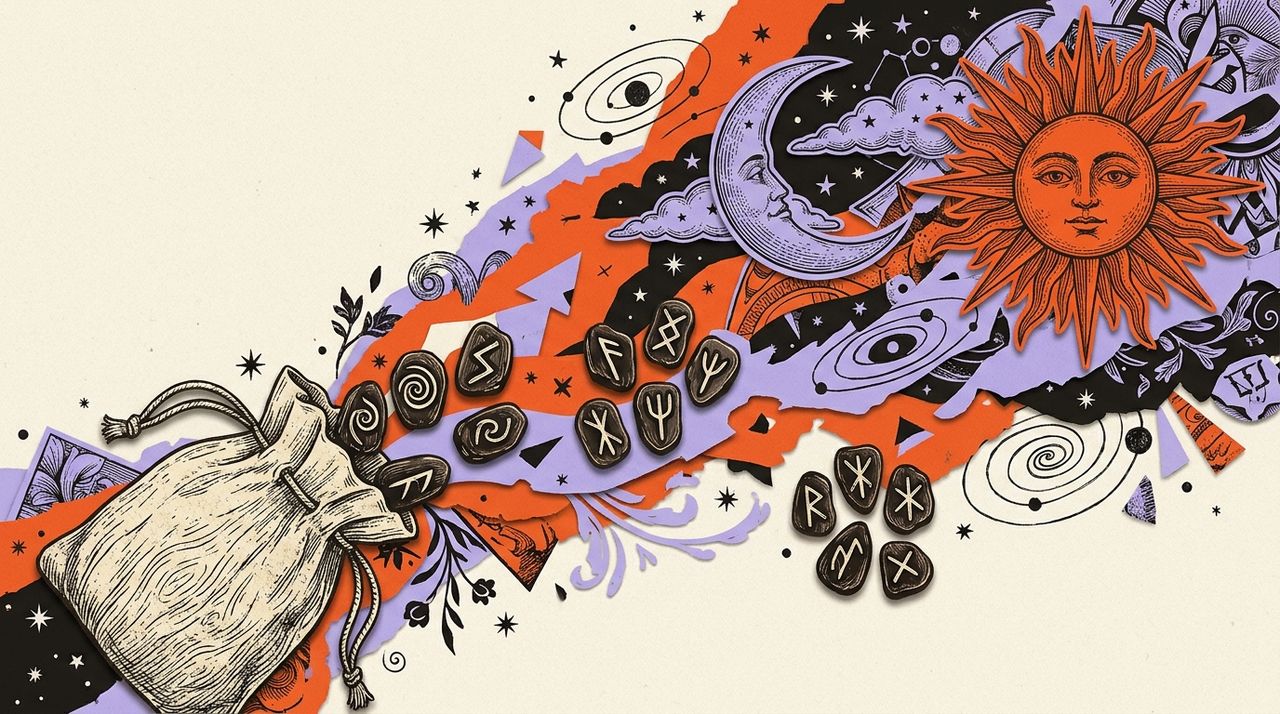
The 24 signs of the Norse alphabet, drawn like an oracle.
Runes are the letters of the ancient Germanic alphabet, the futhark, which has 24 of them. Their modern divinatory use developed in the 20th century.
Each rune has a name and a meaning (Fehu, wealth; Raidho, the journey…); a rune drawn reversed can add nuance to the reading.
Where it comes from
The oldest known runic inscriptions date from the first centuries AD and have been found in Scandinavia and in northern continental Europe. They mostly serve to write a name or a dedication. In the Viking Age, the alphabet was simplified into a so-called "Younger" futhark of 16 signs, the one used on the great runestones of Sweden and Denmark.
The link with divination is less certain than is often claimed. The Roman historian Tacitus describes among the Germanic peoples a casting of lots using wooden rods marked with signs, but nothing proves that these marks were runes. Norse mythology, for its part, tells in a poem of the Edda that Odin hanged himself from the world tree for nine nights to gain knowledge of the runes: a sacred tale, not a description of practice.
The use of runes as an oracle, as we know it today, was built up in the modern era. Germanic esoteric circles took an interest in them in the early 20th century, and part of this symbolism was later misappropriated by Nazi ideology, which explains the caution of many present-day practitioners. The form widespread today, with its bags of engraved stones and interpretation manuals, spread mainly from the 1980s onwards in the English-speaking world.
What it is based on
The Elder Futhark is traditionally divided into three groups of eight runes, the ættir. Each sign bears a name (Fehu, Uruz, Thurisaz…) that denotes a concrete reality: cattle, the aurochs, the giant, hail, ice, the sun. The names of the ancient runes are partly reconstructed from medieval rune poems, Anglo-Saxon, Norwegian and Icelandic.
The reading starts from this concrete image to draw a symbolic meaning from it: Isa, ice, suggests stillness or waiting; Kenaz, the torch, clarity or creativity. Some runes have a symmetrical shape and cannot appear upside down, hence reading systems that vary from one author to another. Many practitioners regard the rune as an invitation to reflect on a dynamic rather than as a fixed answer.
Try it
How it is practised
You draw one rune for a simple question, or three for a situation, often onto a cloth.
In personal practice, you prepare a bag containing the 24 runes, carved on wood, stone or bone, and a pale cloth on which to lay them. You silently formulate an open question, such as "what should I understand about this situation?", then draw blindly. A simple draw takes a few minutes; many people note down their draws in a notebook to reread later.
Rune reading is also offered as a consultation, in person or remotely. The practitioner then draws the runes in front of you or for you, and comments on each sign and the links between them. A session generally lasts from twenty minutes to an hour. It is helpful to ask from the outset which reading system they use and how they treat reversed runes.
What to expect
A rune draw above all offers a pause: an ancient, somewhat austere image that compels you to put into words what you are going through and to look at it from an unexpected angle. It is a prompt for reflection and not a prediction: the value of the draw lies in what you make of it. It is intended for entertainment.
Runes are no substitute for medical, legal or financial advice, nor for psychological support. Be wary of any offer that presents runes as a guaranteed magical protection, sells talismans to “ward off” a foretold danger, or plays on fear of an unfavourable reading to make you come back. A difficult rune does not foretell any certain misfortune.
Glossary
- Futhark
- The name of the runic alphabet, formed from its first six letters (F, U, Th, A, R, K). There is the Elder Futhark of 24 signs and the Younger Futhark of 16 signs.
- Ætt
- Each of the three groups of eight runes in the Elder Futhark (plural: ættir).
- Reversed rune
- A rune drawn upside down, sometimes called merkstave. Depending on the system, it softens, delays or reverses the meaning of the rune; other practitioners do not read it at all.
- Blank rune
- A blank piece added to some modern sets, absent from the historical sources. Those who use it see in it the unknown or what has not yet been decided.
- Rune poem
- A medieval text that devotes a stanza to each rune. These poems are the main source for the names and meanings attributed to the signs.
Frequently asked questions
How many runes are there in a divination set?
Most sets follow the Elder Futhark and contain 24 runes. Some add a blank rune, making 25 pieces, which has no historical basis.
Can you make your own runes?
Yes, and it is a common approach among practitioners: carving or painting the signs on pebbles or wooden discs. Many feel that this work helps them to memorise the runes and their meanings. No rule requires it.
Did the Vikings use runes to predict the future?
The historical sources do not demonstrate this: runes were used first and foremost for writing, and no ancient text describes a method of reading comparable to today's. Present-day rune divination is largely a modern creation.
What question should you ask the runes?
Runes lend themselves better to open questions than to closed ones: “what is holding this project back?” rather than “will I succeed?”. A clear question centred on yourself makes the reading easier. Avoid asking the same question several times in a row.
Articles on Runes
These practices are a matter of belief and entertainment: they are no substitute for medical, legal or financial advice, nor for professional support.
Other practices
Tarot de Marseille
Twenty-two major arcana for reflecting on a question.Belline Oracle
A French 52-card oracle, known for being easy to read.Yes or no reading
One card, one closed question, one answer to reflect on.Western astrology
Reading a personality and a period of life from the position of the planets at birth.Chinese astrology
Twelve animals, five elements and yin and yang, based on the year of birth.Vedic astrology
Indian Jyotish, based on the sidereal zodiac and the lunar mansions.
Get your horoscope every morning
Free, by email, with the occasional offer from a partner psychic platform. Unsubscribe in one click.